
VIP member
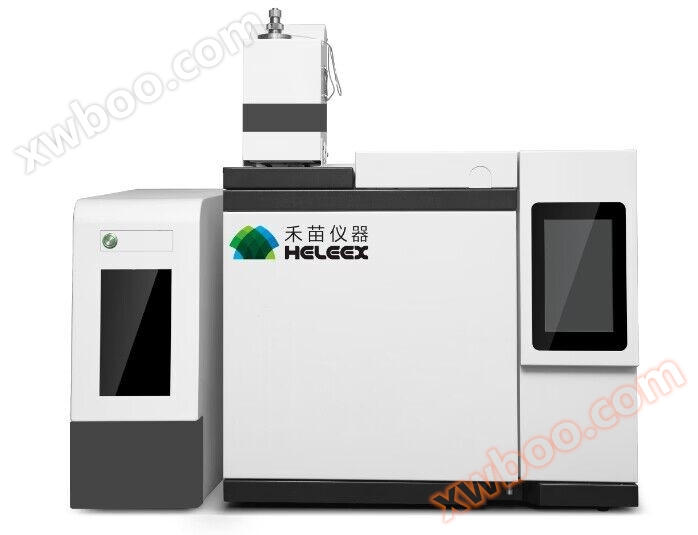
pyrolysis
RoHS is a regulation in the European Union that restricts the use of toxic and hazardous substances in electronic and electrical equipment (EEE). Its
Product details
Features
Ø Quick screening, easy to operate;
Ø The temperature control of thermal cracking adopts programmed heating design;
Ø Thermal cracking is equipped with a heat dissipation system, and the instrument preparation time is short;
Ø The injection process has no cold spots, ensuring repeatability and accuracy;
Ø Sample preparation does not require organic solvents;
Ø Suitable for various sample matrices (gas, liquid, solid);
Ø Professional software, easy to operate;
Ø The temperature and pressure control accuracy of gas chromatography has reached a first-class level, ensuring good test repeatability.
4 Instrument technical parameters and indicators
Py/TDPartial (fully meets the requirements of IEC62321-8:2017): | |
project |
performance metrics |
Thermal cracking/desorption temperature range |
5 ℃ -500 ℃ above room temperature |
temperature control accuracy |
Regarding the target compound,Temperature control accuracy ± 0.2 ℃ |
heating rate |
≤200℃/min |
Analyze temperature control |
Program temperature control |
purge flow |
0-500mL/min |
Interface temperature range |
5 ℃ -400 ℃ above room temperature |
GCpart: | |
Temperature range of injection port |
5 ℃ -350 ℃ above room temperature |
Type of injection port |
Split/No Split |
Column box temperature range |
From 5 ℃ to 450 ℃ above room temperature, increment: 0.5 ℃; Accuracy: ± 0.1 ℃ |
Heating ladder |
Can achieve 16 level program heating |
Other characteristics |
1The advanced 100M/Gigabit Ethernet communication interface and built-in IP protocol stack enable the instrument to realize long-distance data transmission through the enterprise's internal LAN and Internet; Facilitating laboratory setup, simplifying laboratory configuration, and facilitating data analysis management. 2The instrument is equipped with a 7-inch color LCD touch screen that supports hot swapping and can be used as a handheld controller. 3The instrument adopts a multi processor parallel working mode, making it more stable and reliable; Multiple high-performance detectors can be selected, such as FID, TCD, ECD, FPD, and NPD. Up to three detectors can be installed simultaneously, and FID detection has automatic ignition function. 4It adopts a low-noise, high-resolution 24 bit AD circuit and has the functions of baseline storage and baseline deduction. |
5 Analysis Test
5.1 Analysis process
(1) Sample processing
The total mass of the weighed sample is:0.5-1.0 mgFix the sample in the middle of the quartz tube with tweezers and secure both ends with quartz wool; Add the liquid sample directly onto the quartz wool. Then put the quartz tube into the heating device.
(2) Reference conditions
1) Cracking program temperature rise:100℃→(72℃/min)→280℃(2 min)
2) Transmission line temperature:300℃
3) Sample diversion injection: Solid injection weight required≤ 1.5mg, Liquid≤1 ul
4) FIDDetector temperature:300 ℃, injection port temperature:300 ℃
5) temperature-programmed 100 ℃ (maintain) 1 Minute by minute 20 ℃ rises to 300 ℃ (maintain)14Minutes)
(3) Reference results
Reference retention time and time window for each component of phthalate ester compounds
component name |
Retention time (min) |
Time window band (min) |
Diisobutyl phthalate DIBP |
11.094 |
0.05 |
Dibutyl phthalate DBP |
11.663 |
0.05 |
Butyl benzyl phthalate BBP |
14.841 |
0.05 |
Di (2-ethylhexyl) phthalate DEHP |
16.960 |
0.05 |

Reference chromatogram of standard reference materials for phthalates
5.2 Standard curve and linear range
The configuration content is50 ppmThe100 ppmThe250 ppmThe500 ppmand1000 ppmofDBPDraw a standard curve using the peak area of the quantitative component as the y-axis and concentration as the x-axis for the standard solution.
The standard curve and linear correlation coefficient are as follows:
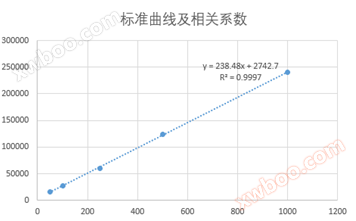
The comparison of peak areas of different concentrations of standard solutions is shown in the following figure:
Standard solution concentration (ppm) |
Peak area (A) |
50 |
15296 |
100 |
26956 |
250 |
59771 |
500 |
124013 |
1000 |
240783 |
According to the baseline noise2The minimum detection limit for signal doubling calculation is approximately50 ppm.
5.3 repetitiveness
The repeatability of the sample was determined, and the results are as follows:
Sample number/peak area |
DIBP |
DBP |
BBP |
DEHP |
1 |
414880 |
405971 |
358762 |
405629 |
2 |
413855 |
401013 |
347080 |
419472 |
3 |
404010 |
396076 |
374528 |
419352 |
4 |
420141 |
412550 |
393896 |
411335 |
5 |
417695 |
408877 |
396347 |
422330 |
6 |
439497 |
417750 |
378398 |
435107 |
RSD(%) |
2.805423 |
1.9223 |
5.155986 |
2.407121 |
The minimum detection limit is approximately50 ppmThe linear correlation coefficient is greater than0.999,RSD≤5.16%SatisfyRoHS 2.0Screening requirements for ortho benzene.
6 working environment
1) Environmental Requirements
The operating temperature is15°C~35°COptimal operating temperature18°C~28°C,1.5hThe internal temperature change is not greater than2°CDue to the large temperature difference in the environment, air conditioning should be installed.
The relative humidity must be within ≤75%Can be equipped with a dehumidifier.
Operation and storage require a non condensing and non corrosive environment.
The maximum dust particle density is80mg/m3.
2) Electrical requirements
Voltage range:220V±10VThe frequency is50Hz.
The power supply has a grounding wire; No strong electromagnetic interference.
have10AInsert board for three pin plug3One.
If funds permit, it is recommended to install an uninterruptible power supply(UPS)Power requirements10KVAThe above.
3) Requirements for instrument installation test bench
Provide sufficient laboratory space for installationPYTheGCThePCDevices such as printers.
The experimental platform must have a flat surface and be stable enough to support the weight of the entire system, includingPYTheGCThePCEquipment such as printers, with a total weight of approximately120kg.
Leave no less than around the experimental platform0.5mPlease do not place it against the wall due to the wide operating and maintenance space.
Suggest installing exhaust equipment above the experimental platform.
Suggested size for instrument installation laboratory bench: length250cm×wide80cm×high75cm.
4) Requirements for sample processing test bench
The sample processing experimental platform is mainly used to place electronic scales and perform sample processing.
The sample processing experimental platform should be stable and durable, and reduce the generation of vibration.
Electronic scales should not be placed near ventilation openings or fans, as strong airflow can affect the weighing results.
The sample processing experimental platform should also have sufficient space for sample processing.
Suggested size for sample processing experimental bench: length120cm×wide80cm×high75cm.
If space is limited, two long instrument installation and sample processing test benches can also be used150cmThe experimental table.
Ø PVCPhthalate esters in China
Analyzing the Regulation of Electronic and Electrical ProductsRoHScommand(IEC 62321 - 8:2017)Restricted phthalates.
Online inquiry
-
Contacts
-
Company
-
Telephone
-
Email
-
WeChat
-
Verification Code
-
Message Content
-